Key take-aways
- Inflation and China’s reopening, or a combination of both, remain the dominant economic themes. The path to normalisation is wobbly but should stabilise after all.
- Given the lack of immediate triggers, investors should stick to housekeeping for now.
- An uptick in inflation in January and a solid growth backdrop have increased the probability of further monetary tightening.
- The current monetary policy stance is slowing credit demand significantly, making additional rate hikes unnecessary.
In terms of the inflation trajectory and reopening of the Chinese economy – the trouble is that the days ahead will not yield much new news in both cases. The minutes from the last FOMC (US Federal Open Market Committee) meeting will need to be digested, and another reading of the Fed's (US Federal Reserve) preferred inflation gauge is due. But in both cases, these will likely only emphasise what we already know about the uncertain rate trajectory going forward.
We stick to the view that inflation is on track to come down substantially in the months ahead, but admittedly, the latest data points have increased the odds of the Fed committing a policy mistake by overtightening rates.
In China, the reopening will keep producing a lot of anecdotal evidence about economic activity going back to normal. Yet official data reports on the breadth and extent of the reopening at the macroeconomic level have not yet been released.
Overall, we expect the reopening to be material for the global economy when it comes to growth but less inflationary compared to the Western experience a year ago. The main reasons: the composition of China’s price indices are food-heavy (i.e. less sensitive to goods and service prices), the housing market will remain a drag, and functioning supply chains will mitigate any sizeable increase in demand.
What’s the big picture for the economy?
On a global scale, there will be leading indicator reports that should confirm the most recent trends. The US is in a cool-down mode, while Europe is stabilising after recovering from the energy shock and thanks to rising demand from Asia. So, all in all, the days ahead are about being patient, since a lot of market-moving news is not expected. Housekeeping is a good distraction during such lulls. Also, opportunities can be found in ‘old economy’ parts of the market.
US Fed outlook: Fuelled by inflation volatility
The decline in US inflation appears to have come to a halt, increasing the likelihood of further monetary tightening. The solid economic backdrop and the US Federal Reserve’s recent ‘higher for longer’ guidance only add to these expectations. After US consumer prices reportedly rose in January and producer prices rose much more than expected, the idea that more interest-rate hikes are needed is gaining traction.
Stronger retail sales have only added to the notion that the US economy needs a more restrictive monetary policy stance to avoid an unhealthy overheating. Hawkish rhetoric from Fed officials arguing for a half-point rate hike at the next meeting has also increased the probability of higher interest rates.
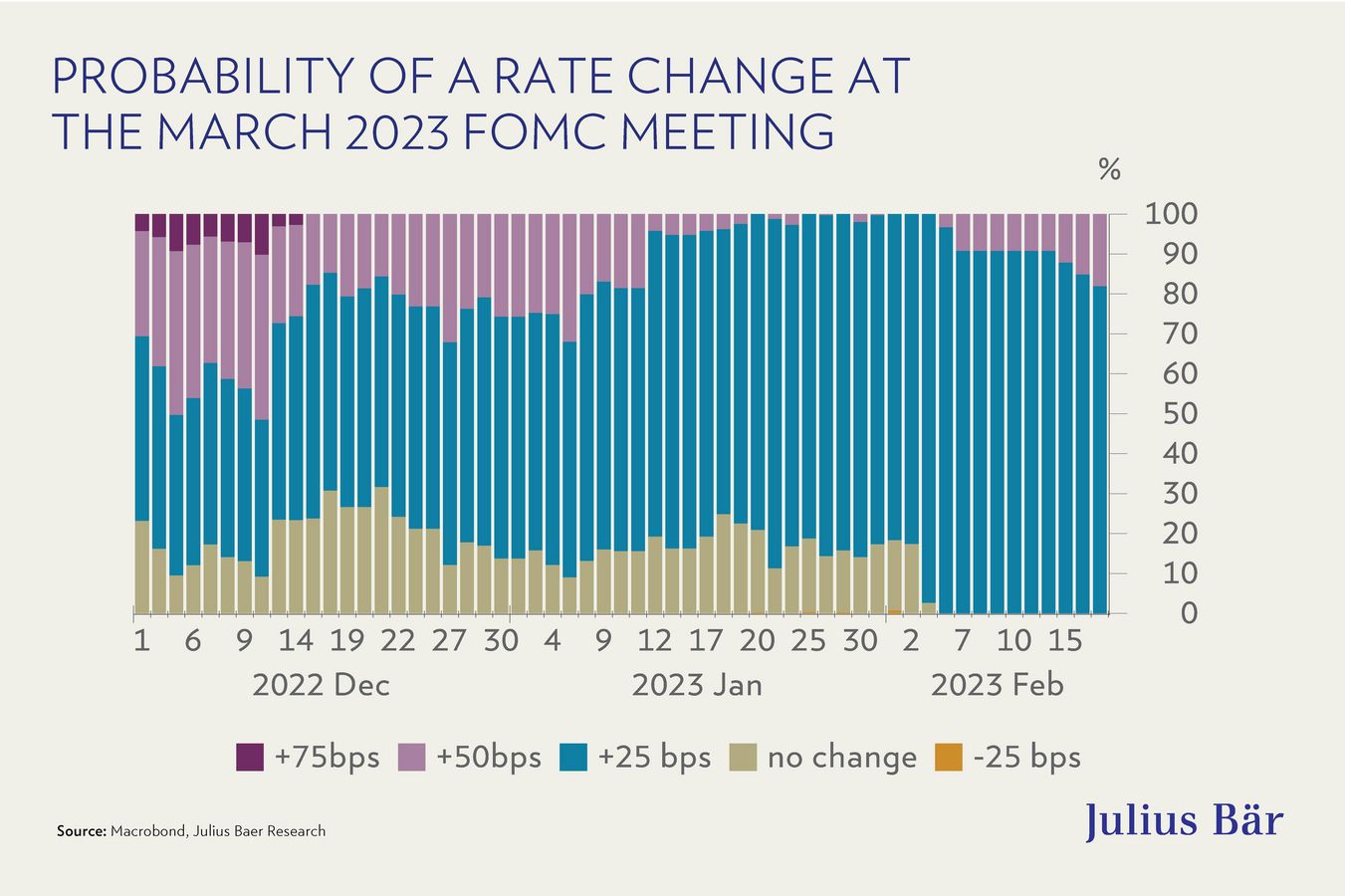
As shown here, a +25bps rate hike (or 0.25 percentage points) has become the most overwhelmingly probable outcome of the March US Federal Open Market Committee meeting, as of February 2023.
However, we mainly attribute the rise in inflation in January to inflation volatility and doubt that the disinflationary trend has reversed. Furthermore, there are no signs of new supply bottlenecks, and the increase in petrol prices, which pushed up inflation in January, is expected to reverse in February. In addition, business activity is weakening, and hiring intentions have cooled.
The current monetary policy stance appears to be quite restrictive, and, as a result, credit demand is slowing sharply. We expect upcoming economic data to confirm the slowdown in the US economy and the associated disinflationary trend, making further monetary tightening unnecessary and reducing the political pressure on the Fed to show its determination in the fight against inflation.
How should you position your portfolio in the view of Julius Baer's experts?
Market Outlook
What is going on in the markets? Julius Baer’s experts share their views.